
Fireplaces Built for Continuous Commercial Use
Commercial fireplace services in Akron for properties where heating systems and aesthetic features must perform reliably under daily operational demands
Fireplace Mike provides commercial fireplace services in Akron, working with property managers, hospitality operators, and business owners who need fireplace systems maintained, repaired, or installed to handle consistent use rather than occasional residential lighting. A commercial fireplace sees far more ignition cycles, longer burn durations, and greater foot traffic exposure than a residential unit, which means the standards for installation, inspection, and servicing differ significantly from what a typical home inspection covers.
Commercial fireplace work begins with a full condition assessment of the firebox, flue system, venting configuration, and any gas or electric components currently in use. Because many commercial properties in the Akron area were built during periods when open-hearth systems were standard for lobbies and dining spaces, the existing infrastructure often includes older masonry that requires evaluation before any new equipment is introduced or a repair sequence is planned. Each phase of work is sequenced to avoid disrupting occupied areas whenever the property layout allows.
Arrange an on-site evaluation to review your commercial fireplace system's current condition and identify any repairs or upgrades the space requires.
How Commercial Fireplace Work Differs From Residential Service
The core difference between residential and commercial fireplace servicing comes down to load and code compliance. A gas fireplace in a hotel lobby or restaurant may run for eight or more hours per day, and the components rated for residential intermittent use are not engineered for that operating profile. Commercial work involves verifying burner ratings, inspecting heat exchanger integrity, confirming that venting meets applicable commercial building code requirements, and in some cases coordinating with HVAC contractors when the fireplace shares a ventilation system with the building's primary mechanical equipment.
After Fireplace Mike completes a commercial service call, the most immediately noticeable change is consistent ignition and flame performance without the delayed starts or incomplete shutoffs that signal component wear. Businesses that use fireplaces as part of their customer-facing environment—restaurants, hotels, event venues—also notice that a properly serviced unit no longer produces odor during operation, which is one of the most common complaints that signals a venting or combustion issue rather than a cosmetic one.
Commercial fireplace service also covers documentation that residential work typically does not require. Property managers often need written records of inspections and any corrective work completed to satisfy insurance carriers or satisfy a landlord's maintenance obligations under a commercial lease.
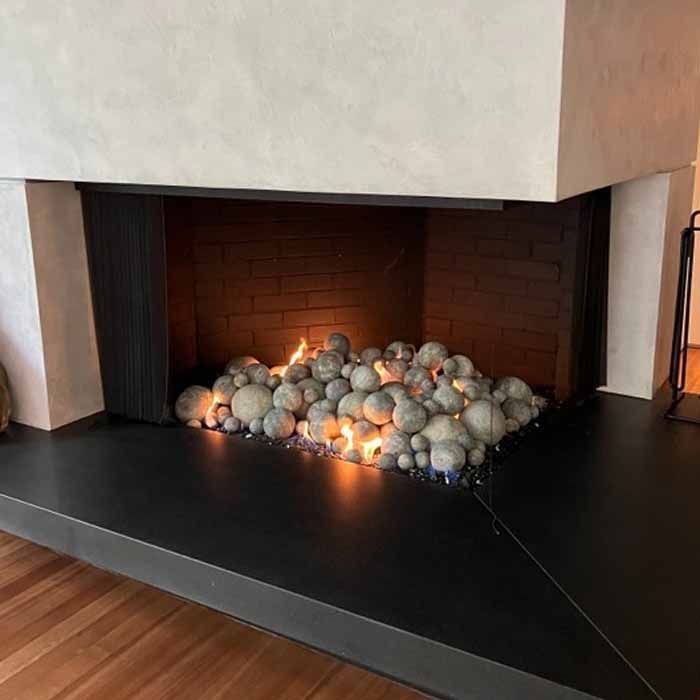
What Property Managers Ask About Commercial Fireplace Work
Commercial properties have specific operational and compliance considerations that shape how fireplace service is scheduled and documented. The questions below address the most common service-specific points that come up during the assessment and repair process.
What does a commercial fireplace inspection actually evaluate?
An inspection covers the firebox interior, flue liner condition, venting termination, burner components, and any gas valve or ignition hardware in place. For masonry systems common in older Akron commercial buildings, the flue liner receives particular attention because deterioration at mortar joints is a frequent finding in structures built before the 1980s.
How does venting configuration affect commercial fireplace performance?
The venting path determines how completely combustion byproducts exit the building, and in commercial settings where mechanical exhaust systems run nearby, negative pressure can interfere with draft. Identifying that relationship early prevents recurring performance issues after servicing is complete.
What causes a commercial gas fireplace to produce odor during operation?
Odor typically points to incomplete combustion, a contaminated burner bed, or a venting obstruction that allows exhaust gases to spill back into the occupied space. Each cause requires a different corrective step, so isolating the source before replacing components avoids unnecessary cost.
Why do ignition components fail faster in commercial fireplaces than residential ones?
Ignition modules, thermopile sensors, and gas valves have cycle ratings, and a unit operated daily in a commercial environment can exceed those ratings within a few years. Replacing components before they fail completely is more practical than addressing an outage during peak operating hours.
How is the work sequenced when a commercial property is occupied during business hours?
Access, noise, and gas shutoff timing are coordinated around the property's operational schedule. Work that requires extended gas isolation is typically planned for off-hours, while visual inspection and minor component work can usually proceed during low-traffic periods without disrupting the space.
Fireplace Mike also provides commercial fireplace services in Canton and the surrounding areas. To schedule a commercial assessment or discuss the scope of work your property needs, connect with Fireplace Mike directly to review the specifics of your building's fireplace system.